Sandy Springs Doesn't Have One Housing Market in 2026. The City's Own Zoning Map Explains Why.
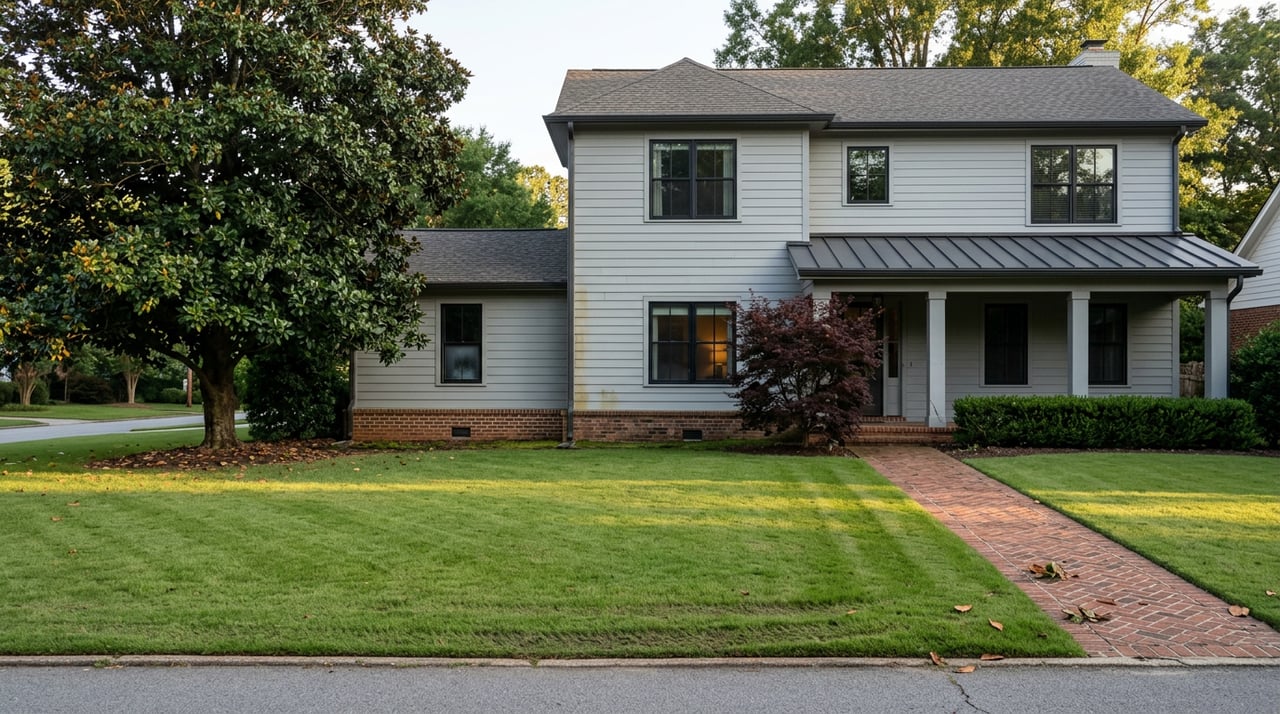
In February 2026, the city of Sandy Springs paid a homeowner on Kayron Drive $157,700 for 0.06 acres of fee-simple right-of-way and a temporary construction easement, the sliver of yard needed to widen Hammond Drive. The homeowner's legal team had asked for $400,000. City Attorney Dan Lee noted during the council vote that it was the second time the same family had lost a piece of property to a road project, the first being a strip taken years earlier for the Johnson Ferry Road widening.
That negotiation will never show up on a comparative market analysis. But it is a small, specific version of something happening across a much wider stretch of the city right now: Sandy Springs is not one housing market cooling or heating in unison. It is two markets, moving in opposite directions, and the line between them is not drawn by school district or curb appeal. It is drawn by the city's own zoning posture, and that posture is about to be written down in more permanent form.
A review of the city's project pipeline and zoning actions describes Sandy Springs' 2026 development pattern as intensification in nodes: large projects clustered near City Springs and the Central Perimeter and MARTA station areas, with most residential neighborhoods held stable and low-density. That is not a slogan. It lines up with a policy the city has held since at least 2017, when it began protecting roughly three-quarters of its land inside residential neighborhoods, parks, and green space, while directing about $172 million in infrastructure spending over the past decade toward the corridors doing the growing.
That posture is now being rewritten into a document that will govern the next twenty years. On June 23, 2026, the city kicked off "The Next Chapter," a twelve-month rewrite of its comprehensive plan and parks master plan, with submission to the state targeted for June 2027. A comprehensive plan carries no legal force on its own, but city boards, staff, and council members routinely point to it when they vote on rezonings. The land-use and character maps being drafted this year, in other words, are the document a future council will hold up when your street's rezoning request comes before it.
Two projects illustrate what "the node" means in practice, and how differently their timelines should weigh on a buyer's decision.
Hillcrest broke ground in October 2025 on 8.1 acres adjacent to the $230 million City Springs complex, on land that had belonged to Sandy Springs United Methodist Church. High Street Residential, the multifamily arm of Trammell Crow Company, and its partner Third & Urban are building 362 apartments, 30 for-rent townhomes, and more than 19,000 square feet of retail around a central plaza, with delivery expected by the end of 2027. The city agreed to put up $4.87 million toward 111 public parking spaces in the project's garage, structured as a ten-year tax abatement rather than a cash grant.
Embassy Row is a longer bet. In April 2026, Insignia filed for a Development of Regional Impact review on its 28-acre Central Perimeter property at 6600 Peachtree Dunwoody Road, proposing 1,068 multifamily units, 111 townhomes, a 159,463-square-foot office building, and 15,300 square feet of retail. The filing lists a 2032 completion date. A project two years from delivery and a project six years from a state filing are not the same variable, even though both sit inside the same node.
The corridor absorbing that new supply is also absorbing a highway widening. The SR 400 Express Lanes project is reshaping the sixteen-mile stretch from the North Springs MARTA station north into Forsyth County, and as of a June 15, 2026 GDOT announcement, construction is underway on six of the project's sixteen one-mile sections, work that continued through the FIFA World Cup's conclusion in mid-July.
Residents of the Northridge Forest neighborhood got a preview of what that means at street level. In early May 2026, crews clear-cut the trees between Huntingdon Trail and the highway, and neighbors described noticeably louder traffic noise at a community meeting days later. One of the most affected homeowners is trying to sell his house mid-construction. GDOT's program manager for the project told Rough Draft Atlanta that sound barriers are not currently planned along that stretch.
Hammond Drive is running its own parallel widening, set to begin by the end of 2026 after the city acquired nearly all of the 37 residential parcels the project requires, most of them 1960s-era homes whose asbestos has driven up demolition costs. Part of that project's funding runs through Fulton County's TSPLOST program, which comes back to voters for renewal this November. A homeowner near that corridor is not just watching construction. They are watching a ballot measure.
Outside the nodes, the story is almost the inverse. On May 19, 2026, the city council unanimously approved three subdivisions adding 26 new single-family homes across sites where seven previously stood, the largest a 21-home development at the Dunwoody-DeKalb border after officials rezoned five lots along Spalding Drive from a one-acre minimum down to 9,000 square feet. Council members attached conditions requiring turn lanes before construction and HOA-maintained buffers, a pattern that suggests infill gets approved only when the traffic math is spelled out in advance. During that debate, Council Member Andrew Chinsky put the tradeoff plainly:
"If we do that, at that point the price of the home is going to be $3-$4 million, and make it really hard for a new family to be able to afford to move into the area."
The same protected interior is getting an amenity, not just a hold. On April 7, 2026, the council awarded Eastern Builders a nearly $4 million contract to build Old Riverside Park, 23 wooded acres along the Chattahoochee at 6500 Old Riverside Drive, with completion expected before the end of 2026. Mayor Rusty Paul called it "one of those jewels that we come to appreciate," and Council Member Chinsky noted the city rarely gets the chance to build a park like it, given how built out Sandy Springs already is. The project has been on the books since 2012.
Pull citywide numbers and Sandy Springs looks like a market cooling in place. Break the same window down by submarket and property type, and the picture changes.
| Segment | Median price | Year-over-year | Days on market |
|---|---|---|---|
| Citywide (3 months ending April 2026) | $700,000 | down 3.1% | 41, up from 34 |
| Sandy Springs ITP submarket (3 months ending April 2026) | $885,000 | down 13.7% | 54, unchanged |
| Single-family homes sold (April 2026) | $1,125,000 | up 28.17% | 12 |
| Condos sold (April 2026) | $250,000 | down 9.91% | 46, down from 87 |
The citywide figure is an average of a construction discount near the nodes and a low-density hold everywhere else, and it moves in the direction of whichever segment sold more that month. Inside the Perimeter, prices are actually softening even as unit sales climb, roughly the shape you would expect while a highway widening and hundreds of new rental units land at once. In the same window, single-family homes on larger lots, the product the comp plan is holding stable, posted their sharpest year-over-year gain in recent memory.
A citywide median cannot tell you which of these two markets a specific listing belongs to. Three questions can.
Does more construction near City Springs mean prices there will keep falling? Not necessarily. The ITP discount reflects near-term disruption from the highway widening and new supply, not a verdict on long-term demand. Hillcrest's 2027 finish line argues for treating the current pricing as a window rather than a permanent ceiling.
Will the comprehensive plan rewrite actually change zoning where I'm looking? The plan itself carries no legal force, but the council has a track record of citing it directly when it votes on rezonings, as it did in May with the Spalding Drive approval. Worth asking about before you write an offer.
Should the TSPLOST vote factor into a decision near Hammond Drive? If the address sits along a corridor whose funding depends on that renewal, yes. A no vote in November could stretch a construction timeline that buyers are already pricing in.
Comparing two Sandy Springs addresses this year means comparing two different bets, one on node intensification and one on protected low density, and the city has been telling anyone paying attention which bet it's making where. If you're weighing a listing near City Springs against one off Mount Paran, Powers Ferry, or Riverside, The LaMon Team can walk through what each specific address is actually pricing in, from the nearest project's delivery date to what the draft comp plan maps say about your street. Let's Connect.
Get assistance in determining current property value, crafting a competitive offer, writing and negotiating a contract, and much more. Contact us today.